
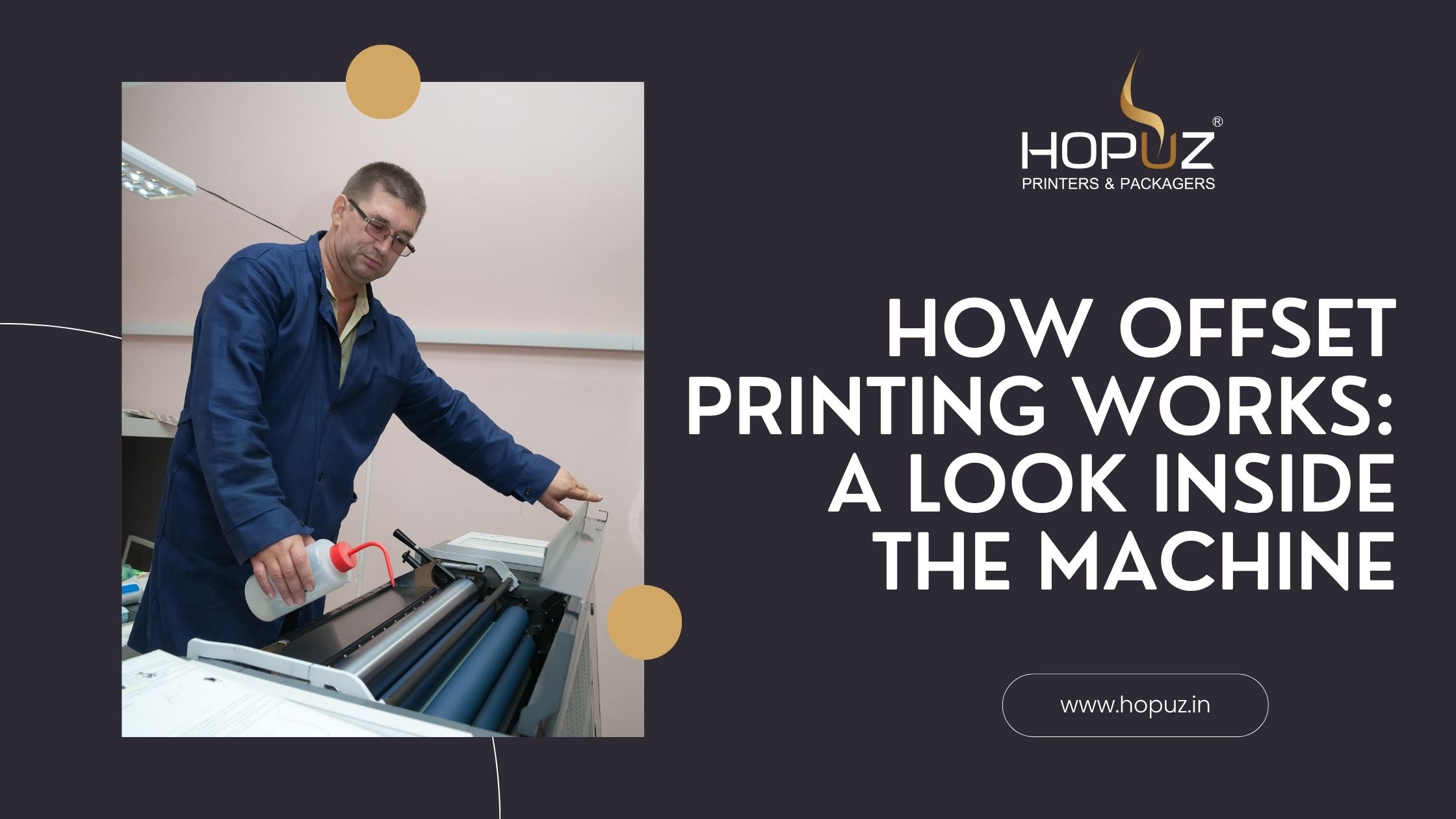
Offset printing has survived the centuries as one of the most affordable and reliable methods of producing quality print material. From books and brochures to labels and packaging, offset printing is committed to its cause of offering services to industries in Kerala—specifically burgeoning regions such as Calicut, Malappuram, Wayanad, and Kannur.
But what exactly goes on inside an offset printing machine?What makes it capable of delivering such sharp, vivid, and uniform results? In this blog, we’ll take a deep dive into the fascinating inner workings of offset printing and why it remains the backbone of the commercial printing industry.
What Is Offset Printing?
Offset printing is a traditional technique where an image is first transferred from a metal plate to a rubber blanket, and then printed onto paper. Unlike computer-printed digital printing, it has numerous mechanical steps one has to take to achieve quality and accuracy.
This technique is suited for mass printing with better-quality photos and color detection. No wonder offset printers in calicut and other Kerala city centers still use this technique for regular printing needs.
Principles under Offset Printing
Offset printing is based on two extremely simple but powerful principles:
Oil and Water Don’t Mix: Oil-based ink (ink is oil) is applied to image zones in the plate, and water keeps ink away from non-image zones.
Indirect Printing: The image isn’t printed directly from the plate onto paper. Rather, it’s copied onto a rubber blanket first, which then rolls out the picture onto paper.
It is this secondary way that allows printing on so many different types of surfaces and makes it more flexible and accurate.
Key Components of an Offset Printer
Now, let’s discuss the most significant components of an offset press and what they’re used for.
1. Printing Plate
The printing plate, usually crafted from aluminum, holds the image that will be transferred onto paper. There’s a different plate for each color (typically CMYK – Cyan, Magenta, Yellow, Black).
Purpose: Supplies printing plate stability and propels plate toward inking and dampening systems.
Why It Matters: Enables sharpness and precise color separation.
2. Plate Cylinder
This cylinder holds the printing plate in place and revolves to bring the plate to press against the inking and dampening systems.
Function: Places inked image onto blanket.
Why It Matters: Provides accuracy and timing at all moments.
3. Blanket Cylinder
A rubber-coated cylinder that transmits pressure from the image of the plate to paper.
Function: Shock absorber between plate and paper.
Why It Matters: Allows printing on curvily surfaced surfaces with even quality.
4. Impression Cylinder
This roll pushes the paper against the blanket cylinder to achieve even image transfer.
Function: Ink transfer presses.
Why It Matters: Prevents the print from becoming flat and opaque.
5. Inking System
It’s an advanced mechanism that uses multiple rollers to ensure uniform ink distribution across the plate.
Key Components: Ductor roller, distributor roller, form roller, and ink fountain.
Why It Matters: Consistent ink distribution prevents smudging and ensures clean, high-quality prints.
6. Dampening System
Provides water to non-image areas of the plate so that ink will not stick there.
Function: Averts unwanted ink-free space.
Why It Matters: Smear-free transparent images and no background smear.
7. Feeder System
Folds single sheets (in sheet-fed presses) or endless rolls (in web presses) into the press.
Function: Place paper into the press with precision.
Why It Matters: Prevents jamming and correct paper alignment.
8. Delivery System
This module, after printing, piles sheets to be dried or further finished.
Function: Organizes and aggregates output.
Why It Matters: Lower inefficiency in workflow and fewer damages.
9. Control Panel
New off-presses have computer-controlled temperature, ink flow, and alignment control panels. Remote monitoring is also featured in some others.
Function: Real-time operation and quality control.
Why It Matters: Uniformity and lower waste.
The Offset Printing Process: Piece by Piece
This is how it all comes together:
Preparation of Plate: One plate per colour.
Inking & Dampening: Water and ink on the plate.
Image Transfer: Image is transferred from the blanket to the plate.
Printing: Impression cylinder prints image on paper.
Finishing: Printed sheets are dried up and stacked up for subsequent processes.
All this is done at extremely high speeds—some printers print tens of thousands of pages an hour.
Offset Printing across Kerala
Let us now have a quick look at how offset printing gets businesses hummed in major cities:
Offset Printing in Malappuram
The offset printing malappuram varies from school books to sacred books with a large customer base. Low-cost, bulk printing is its strength—hence the offset is its choice.
Offset Printers in Calicut
Calicut’s thriving commercial hub is totally reliant on offset printing for business cards, brochures, catalogs, and marketing materials. Offset printers here are adopting new technology without diluting quality prints.
Offset Printing in Wayanad
The offset printing in wayanad is turning towards green inks and soy inks as an option in keeping with increased awareness of going green. Printing centers here contribute to the conservation of nature and precise printing.
Offset Printing in Kannur
With its handloom and textile business calling for tonnage of packaging materials, labels, and tags, Kannur is brimming with such needs through the fast, accurate, high-quality production of offset printing.
Why Offset Printing Still A Great Option
While digital printing has been the rage, offset remains so well-liked for the following reasons:
- Gigantic volume at very low cost
- Superb picture quality
- High material compatibility
- Lightning-fast color reproduction
- Long plates for long print runs
From regional print media of the state to local retailers, the process of offset printing is seen through and through Kerala.
Conclusion: Hopuz – Your Trusted Offset Print Partner
The understanding of the way offset printing occurs makes you appreciate how science, precision, and craftsmanship are involved with every one of the printing processes. From feeding paper to stacking flawless prints, every aspect of the machines has its particular role.
At Hopuz, we apply today’s offset technology along with unexcelled professionalism in striving to provide you with best-of-breed print solutions. If you are looking for offset printers in Calicut, require dependable offset printing in Malappuram, look for environmentally friendly printing in Wayanad, or require bulk solutions towards offset printing in kannur—Hopuz is at your service.
With quality, speed, and service being our hallmark, Hopuz is your premier print solutions provider in Kerala.